
You try to eat healthy. However, you may still feel tired or low on energy.
Because of this, many people ask an important question: what multivitamins should I take?
Multivitamins are the supplements that most commonly used worldwide. Yet choosing the right one can feel confusing. That is why this guide explains multivitamins in a clear, evidence-based, and safety-focused way. As a result, you can make a confident and informed decision for your wellbeing.
What Are Multivitamins? (Simple Medical Explanation)
Contents
- 1 What Are Multivitamins? (Simple Medical Explanation)
- 2 Why Do People Take Multivitamins?
- 3 What Multivitamins Should I Take? (By Age & Gender)
- 4 What to Look for in a High-Quality Multivitamin
- 5 Are Multivitamins Safe to Take Daily?
- 6 Do Multivitamins Really Work? (Evidence-Based Insight)
- 7 Conclusion: Choosing the Right Multivitamins
- 8 Frequently Asked Questions (FAQs)
- 8.1 1. Do I really need a multivitamin if I eat healthy?
- 8.2 2. When is the best time to take a multivitamin?
- 8.3 3. Can multivitamins increase energy levels?
- 8.4 4. Are multivitamins safe for daily use?
- 8.5 5. Should I take a multivitamin or individual supplements?
- 8.6 6. Can multivitamins cause side effects?
- 8.7 7. Are gummy multivitamins as effective as tablets or capsules?
- 8.8 8. Do men and women need different multivitamins?
- 8.9 9. Can multivitamins prevent diseases?
- 8.10 10. How long should I take a multivitamin?
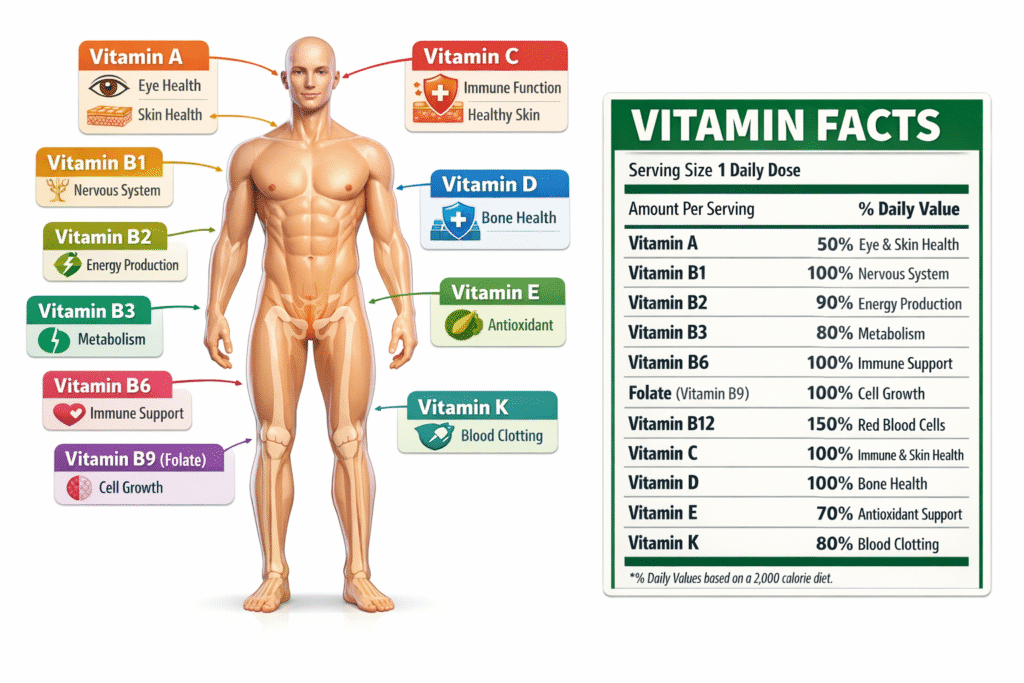
Multivitamins are dietary supplements that contain a combination of essential vitamins and minerals. These nutrients help the body perform normal daily functions.
They are designed to support nutritional gaps. In other words, multivitamins do not replace a healthy diet. Instead, they work best when used alongside balanced meals.
According to the National Institutes of Health (NIH), multivitamins may help people who do not meet their daily nutrient needs through food alone.
Most standard multivitamins contain:
- Vitamins A, C, D, E, and K
- B-complex vitamins
- Minerals such as zinc, magnesium, iodine, and selenium

Why Do People Take Multivitamins?
Even people who eat a reasonably healthy diet may still fall short in certain nutrients.
Population studies and nutrition guidance show common deficiencies in:
- Vitamin D
- Vitamin B12
- Magnesium
- Iron (especially in menstruating women)
The Centers for Disease Control and Prevention (CDC) highlights vitamin D and iron as common public health concerns.
Because of this, multivitamins are often used to help support:
- Normal energy metabolism
- Immune system function
- Bone and muscle health
- Brain and nerve function
What Multivitamins Should I Take? (By Age & Gender)
There is no single “best” multivitamin for everyone. Instead, nutritional needs vary by age, gender, and life stage.
Multivitamins for Women
Women often need nutrients that support blood health and bone strength.
A multivitamin for women may include:
- Iron (if menstruating and medically appropriate)
- Folate, preferably as methylfolate
- Calcium and vitamin D
The World Health Organization (WHO) recognizes iron and folate as essential nutrients for women of reproductive age.
Multivitamins for Men
Men usually require less iron and benefit more from mineral balance.
A multivitamin for men often includes:
- Little or no iron
- Zinc and magnesium
- B-complex vitamins
The NIH cautions that excess iron intake may be harmful in adult men without deficiency.
🔗 External source:
https://ods.od.nih.gov/factsheets/Iron-Consumer/
Multivitamins for Adults Over 50
As people age, the body absorbs certain nutrients less efficiently.
Multivitamins for adults over 50 often focus on:
- Higher vitamin D and vitamin B12
- Lower iron content
- Minerals that support bone health
NIH guidance notes that vitamin B12 absorption commonly declines with age.
🔗 External source:
https://ods.od.nih.gov/factsheets/VitaminB12-Consumer/
What to Look for in a High-Quality Multivitamin
Not all multivitamins meet quality and safety standards. Therefore, reading labels carefully is important.
When choosing a multivitamin, look for:
- Age- and gender-specific formulas
- Nutrients close to 100% of the Daily Value
- Vitamin D3 instead of D2
- Third-party testing from organizations like USP or NSF
- Clear and transparent ingredient labels
Third-party testing helps confirm quality, purity, and accurate labeling.
About third-party certification:
🔗 NSF supplement certification
https://www.nsfsport.com/
Are Multivitamins Safe to Take Daily?
For most healthy adults, daily multivitamins are considered safe when used as directed.
To use them safely:
- Take multivitamins with meals
- Avoid stacking multiple supplements with the same nutrients
- Do not exceed recommended doses
- Consult a healthcare professional if you take medications or have medical conditions
The NIH confirms that supplements are generally safe when intake stays within recommended limits.For most healthy adults, daily multivitamins are considered safe when used as directed.
🔗 External source:
https://ods.od.nih.gov/factsheets/list-all/
Smart Safety Tips
- Take multivitamins with meals
- Avoid stacking supplements
- Do not exceed recommended doses
- Consult a healthcare professional if on medication
Do Multivitamins Really Work? (Evidence-Based Insight)
Large research reviews show that multivitamins:
- Do not cure diseases
- Help prevent nutrient deficiencies
- Support long-term nutritional adequacy
Harvard T.H. Chan School of Public Health describes multivitamins as a form of “nutritional insurance,” especially for people with dietary gaps.
🔗 External source:
https://www.hsph.harvard.edu/nutritionsource/multivitamin/
Conclusion: Choosing the Right Multivitamins
So, what multivitamins should you take?
Ultimately, choose a multivitamin that matches your age, gender, and lifestyle. It should be balanced, quality-tested, and used alongside healthy eating habits.
When chosen wisely, multivitamins can support energy, immunity, and overall wellbeing.
⚠️ Medical Disclaimer
This material is meant to support health education, not replace personalized medical care. For safe and appropriate supplement use, consult a certified healthcare professional.
Frequently Asked Questions (FAQs)
1. Do I really need a multivitamin if I eat healthy?
Even with a healthy diet, some people may still miss certain nutrients. For example, vitamin D, vitamin B12, and iron are commonly low due to lifestyle, age, or limited sun exposure. Because of this, a multivitamin can help support nutritional gaps. However, it should not replace balanced meals.
2. When is the best time to take a multivitamin?
Most multivitamins are best taken with a meal. Taking them with food can improve absorption and reduce stomach discomfort. In general, morning or lunchtime works well for most people.
3. Can multivitamins increase energy levels?
Multivitamins do not act like stimulants. However, if fatigue is related to low levels of nutrients such as iron, B vitamins, or vitamin D, correcting these deficiencies may help improve energy over time.
4. Are multivitamins safe for daily use?
For most healthy adults, daily multivitamins are considered safe when taken as directed. That said, exceeding recommended doses can be harmful. Therefore, always follow label instructions and consult a healthcare professional if you take medications or have health conditions.
5. Should I take a multivitamin or individual supplements?
A multivitamin provides a broad range of nutrients in balanced amounts. In contrast, single-nutrient supplements are usually recommended only when a specific deficiency is diagnosed. Because of this, many people prefer multivitamins for general nutritional support.
6. Can multivitamins cause side effects?
Most people tolerate multivitamins well. However, some may experience mild nausea or stomach upset, especially if taken on an empty stomach. Taking them with food usually helps. High doses of certain vitamins or minerals can cause problems if taken long term.
7. Are gummy multivitamins as effective as tablets or capsules?
Gummy multivitamins can be easier to take, especially for those who dislike pills. However, they often contain added sugars and may have lower amounts of some nutrients. Therefore, always check the nutrition label before choosing gummies.
8. Do men and women need different multivitamins?
Yes, nutritional needs often differ by gender. For example, women may need more iron and folate, while men usually need less iron. Because of this, gender-specific multivitamins are often a better choice.
9. Can multivitamins prevent diseases?
Multivitamins cannot prevent or cure diseases. However, they may help reduce the risk of nutrient deficiencies, which supports overall health when combined with a healthy lifestyle.
10. How long should I take a multivitamin?
Many people take multivitamins long term as part of their daily routine. However, needs can change with age, diet, or health conditions. Therefore, it is a good idea to review supplement use with a healthcare professional from time to time.